Tag: Innovation

Novo Fintech Firm Chooses to Grow in DE

Forbes Fintech 50 Firm Novo Chooses Delaware as Expansion Site

Florida-based fintech platform for small businesses plans to grow as part of the Wilmington financial services hub


WILMINGTON, Del. – Novo, the powerfully simple financial solutions platform for small businesses that is a two-time member of the Forbes Fintech 50, has chosen to expand in Wilmington, Delaware.

Novo has built a platform for small businesses that combines a checking account with an ecosystem of financial applications — helping small businesses access their revenue faster, save time on business-critical tasks and manage their money anytime on any device. Since launching in 2018, Novo has surpassed $20 billion in small business transactions and was named to the Forbes Fintech 50 list, which highlights “the top private companies that are transforming finance through technology” in both 2022 and 2023.

Novo logo

Novo is headquartered in Miami and recently opened a U.S. location in Wilmington. In Delaware, the company is operating from the Stat International space on Orange Street. Novo has hired a dozen employees since May and will continue to grow the office in the coming years.

“Novo’s decision to expand to Wilmington is great news for the First State,” said Governor John Carney. “We want to be the place companies consider when starting and growing their businesses. Novo’s move to Wilmington shows that our efforts to make Delaware inviting to corporations are working and that the Delaware Prosperity Partnership is making a difference.”

One of Novo’s recently developed offerings is Novo Funding, a fast and flexible way for small businesses to access working capital. Since its launch, Novo Funding has issued more than $70 million in working capital.

Novo’s decision to choose Delaware for its expansion further confirms the state’s status as a hub for financial services and fintech companies. Wilmington and its environs continue to be the site of significant growth for existing businesses in the financial services and fintech sector while also attracting new firms to the area. Companies with recent Delaware expansions include Ally Financial, City National Bank, Goldman Sachs and JPMorgan Chase.

“Small businesses make up more than half of Delaware’s workforce — an incredible testament to the work Delaware has done to make small business creation and growth as accessible as possible,” said Grant Sahag, VP of Operations at Novo. “The Novo team is honored to be a part of Delaware’s thriving small business community.”

###

Person using Novo app on phone

About Delaware Prosperity Partnership

Created in 2017, Delaware Prosperity Partnership (choosedelaware.com) is the nonprofit public/private organization that leads Delaware’s statewide economic development efforts to attract, grow and retain businesses; build a stronger entrepreneurial and innovation ecosystem; and support private employers in identifying, recruiting and developing talent.

About Novo

Novo Platform, Inc. (“Novo”) is the powerfully simple financial platform for small businesses. To learn more, visit www.novo.co.

Disclosure

Novo is a fintech, and not a bank. Novo acts as a service provider to Middlesex Federal Savings, F.A., and the deposit and banking products obtained through the Novo platform are provided by Middlesex Federal Savings, F.A. Middlesex Federal Savings, F.A. is a federal savings bank and an FDIC-insured depository institution (FDIC Certificate 28368). Deposits made at Middlesex Federal Savings, F.A. through the Novo platform receive FDIC insurance protection on a pass-through basis up to the applicable legal limit. When determining the amount of your deposits covered by FDIC insurance, please note all deposits you make through the Novo platform will be aggregated with all deposit accounts of the same ownership and/or vesting held at Middlesex Federal Savings, F.A. and Middlesex Federal Savings, F.A. brands. Additional information regarding FDIC insurance coverage is available at www.fdic.gov. Merchant Cash Advance products and services are offered by Novo Funding LLC (“Novo Funding”), a wholly owned subsidiary of Novo. Merchant Cash Advances require a Novo checking account.

Newsletter Sign Up

Stay Up To Date With Delaware

Continue reading

Delaware Hosts Hydrogen Hub Conference

Carney, Carper, Coons, Blunt Rochester Host Energy Department at Hydrogen Hub Conference


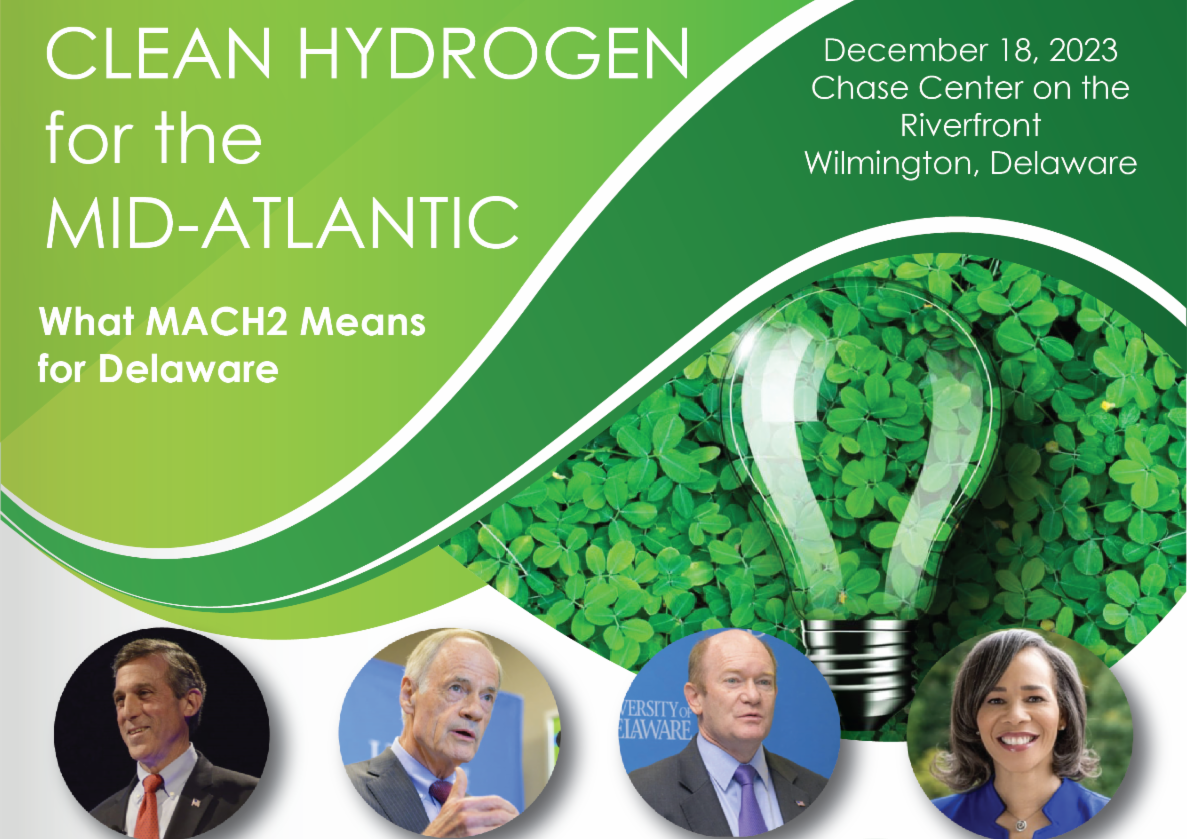
WILMINGTON, Del. – Governor John Carney, U.S. Senators Tom Carper and Chris Coons, and Congresswoman Lisa Blunt Rochester (all D-Del.) hosted U.S. Department of Energy (DOE) Deputy Secretary David Turk at the Clean Hydrogen for the Mid-Atlantic Conference at the Chase Center on the Riverfront to discuss the economic and environmental benefits of clean hydrogen to Delaware with more than 300 stakeholders from around the region. In October, the DOE chose the Mid-Atlantic Clean Hydrogen (MACH2) proposal, a public-private partnership between Delaware, southeastern Pennsylvania, and southern New Jersey, as one of seven regional clean hydrogen hubs. This designation came with a $750 million federal grant that was made possible by the Bipartisan Infrastructure Law.

Topics covered during the half-day event included how the hub would positively impact regional economies, public health, and the environment. Guests and panelists throughout the event included Bloom Energy’s Rick Buettel, Chesapeake Utilities’ Shane Breakie, First State Hydrogen’s Andrew Cottone, PBF Energy’s Matt Lucey, DART’s Michael McNeal, University of Delaware Center for Clean Hydrogen’s Yushan Yan, State Senator Stephanie Hansen (D), Cheyney University of Pennsylvania’s Pamela Keye, State Representative Larry Lambert (D), Steamfitters Local 420’s Jim Snell, and Delaware Workforce Development Board’s Joanna Staib.

MACH2 will advance President Biden’s goal of a 100% clean electrical grid by 2035 and net-zero carbon emissions by 2050, strengthen our nation’s energy security, and create an estimated 20,000 good-paying clean energy jobs, including union jobs. MACH2 will produce, distribute, and use clean hydrogen to power our vehicles, airplanes, industries, and more. The proposal was chosen largely due to the highly trained, unionized workforce in Delaware and the surrounding area, as well as the region’s strong manufacturing, chemical, and bioscience presence and existing infrastructure capable of transporting and storing hydrogen.

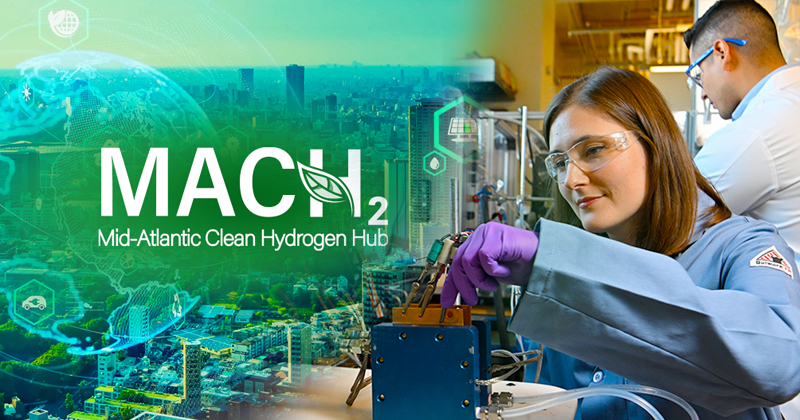
Mach2 logo

“Hydrogen hubs present a win-win-win for our climate, our communities and union workforce, and for the economy,” said David Turk, Deputy Secretary of the Department of Energy. “Clean hydrogen is the Swiss Army Knife of clean energy technologies. It can decarbonize some of our hardest-to-abate sectors, like heavy industry and transportation, and can provide long-duration energy storage. With this investment in the MACH2 Hub, DOE is eager to help build this indispensable network of hydrogen producers, consumers, and connective infrastructure in the region, while creating an estimated 20,000 jobs.”

“To be one of seven regional hydrogen hubs chosen by the U.S. Department of Energy – out of 79 that originally started the process – is a really big deal,” said Governor John Carney. “This designation will bring $750 million for Delaware and our partners in the region to build a clean energy industry that will create thousands of good union jobs. And Delaware communities are a significant part of this plan. The point of cleaner energy is to make things cleaner and better for people – especially those who live in disadvantaged communities. There will be an opportunity at each stage for the Delawareans to weigh in and shape these projects, and we encourage the public to participate.”

“Today’s conference brought together leaders from different levels of government, industry, labor, and academia to discuss how we are working together to grow the clean hydrogen energy sector in Delaware,” said Senator Tom Carper, Chair of the Senate Environment and Public Works Committee. “Clean hydrogen has a critical role in reducing greenhouse gas emissions and helping us meet our nation’s climate goals, while also creating good-paying jobs. Thanks to our region’s first-class labor workforce, existing infrastructure, and research and development capabilities, the future of the Mid-Atlantic Clean Hydrogen Hub is bright.”

“As the nation’s lowest-lying state, Delaware faces particularly acute challenges from climate change-related natural disasters, and so a transition to energy sources like clean hydrogen is crucial for our state,” said Senator Chris Coons, Co-Chair of the Bipartisan Senate Climate Solutions Caucus. “To do that, we can’t leave behind the workers and the infrastructure and the systems that we’ve built. MACH2 is a critical opportunity to transition the skills of Delaware workers, upgrade the facilities of our local refineries and industrial pipelines and manufacturing facilities, and innovate, innovate, innovate. We have an opportunity here to show that we can transform, and that we can compete, and if we do that, we won’t just save our world and our climate – we will save our communities, as well.”

Clean Hydrogen for the Mid-Atlantic Conference logo with speakers and time.

“The big takeaway from today’s conference is that we all have a part to play in turning the vision of MACH2 into action – from elected officials and universities to businesses and environmental justice advocates – as we invest in clean hydrogen production and create-good-paying jobs in an equitable, just, and sustainable way,” said Congresswoman Lisa Blunt Rochester, member of the House Energy and Commerce Committee. “Delaware has the ideal infrastructure, workforce, and positioning for the MACH2 framework, and I am eager to see the First State take its place at the center of our clean energy future.”

Newsletter Sign Up

Stay Up To Date With Delaware

Continue reading

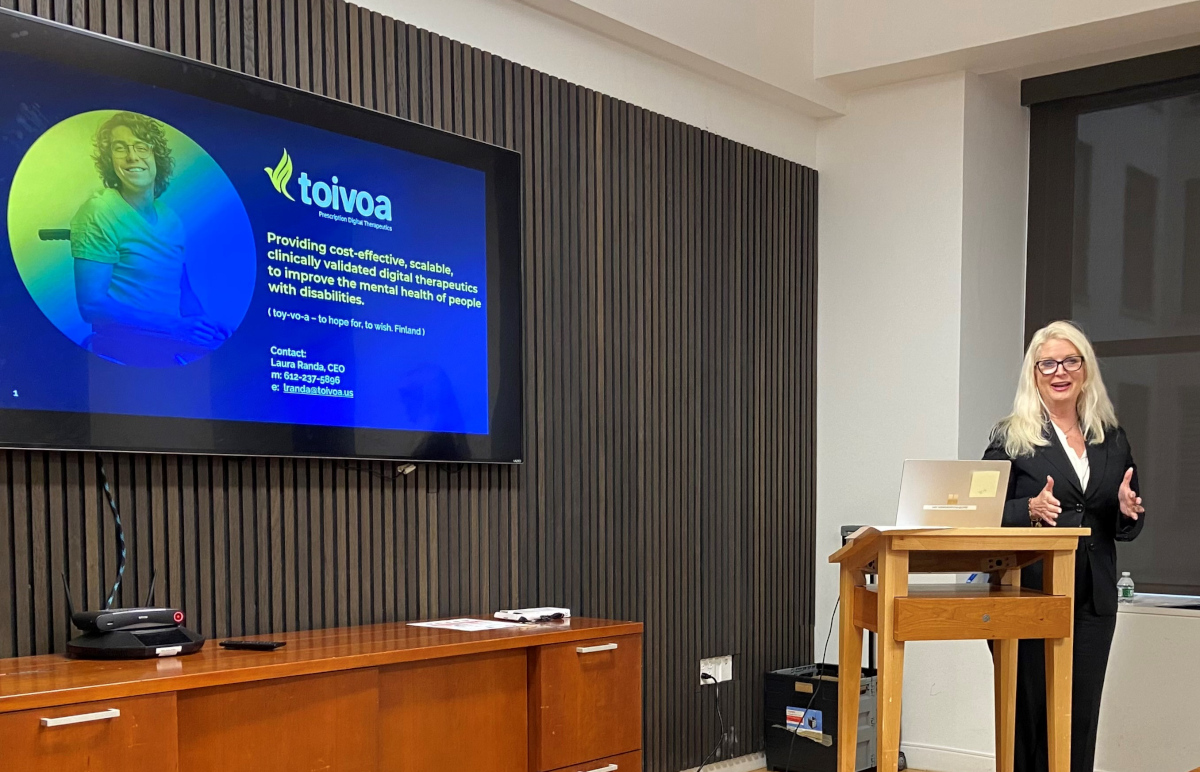
Laura Randa, CEO & Chair of Toivoa

Laura Randa, CEO and Chair of Prescription Digital Therapeutics Firm Toivoa

An Ongoing Series Highlighting Delaware Innovators


The United States is facing a severe mental health crisis that disproportionately impacts people with disabilities. It’s estimated that 54 million people with disabilities are suffering from mental health disorders and, according to the Centers for Disease Control, adults with disabilities say they experience frequent mental distress nearly five times as often as those without disabilities. But mental health services are often not easily accessible, widely available or affordable.

Laura Randa witnessed first-hand how her college-age daughter, who has hearing loss, experienced increased stress and anxiety while struggling to read lips during the COVID-19 pandemic, when face coverings were mandatory and clear masks weren’t available in most classrooms. Fortunately, Randa was in a position to help.

Laura left her 30-year career in commercial leadership and C-suite positions at biotech and pharmaceutical companies, including Regeneron Pharmaceuticals and Novartis, determined to revolutionize mental health treatment for people with disabilities. Assembling a passionate team of experts in cognitive behavioral therapy, digital therapeutics and clinical psychology, Randa started Wilmington-based Toivoa and its first-in-class digital therapy platform, Rauha, a platform designed to close the treatment gap for people with disabilities living with mental illness. The 2-year-old Wilmington-based company won $27,000 in the 2023 Startup302 competition, coordinated by Delaware Prosperity Partnership (DPP).

Toivoa, a Finnish word that means “hope,” is initially targeting its efforts for people with hearing and mobility disabilities and includes dozens of accessibility functions such as color contrast, closed captions, keyboard mobility and multiple navigational options. By the end of the decade, Randa expects to hire upwards of 1,000 people and have 1,300,000 patient users on the platform.

Initiated by a healthcare professional and accessed by a unique patient code, the Rauha app provides fully-accessible, cognitive behavioral therapy – the gold standard of psychotherapy. Based on responses to a series of questions about their disabilities, patients receive adapted, personalized exercises and therapy from Dr. Samantha Gaiez, a New York City-based clinical psychologist with more than 15 years of clinical experience, and a team of psychologists specializing in people with disabilities. Every patient will be matched to a certified mental health coach who has shared living experiences with disabilities and mental illness. Together with a vibrant patient community forum, patients will receive personalized support and encouragement throughout their 12-week journey.

“We are on a mission to radically change evidence-based therapy for people with disabilities living with mental illness,” says Randa, who earned her master’s degree in public administration from the University of Delaware. “We look forward to bringing a high-growth digital therapeutic community to Delaware and collaborating with the county and state economic development teams to address critical health inequities in one of the most excluded and marginalized groups.”

Randa recently shared her thoughts on innovation with DPP.

Why is Delaware a great state to be an innovator?

I grew up in Delaware and have seen first-hand that Delaware is the home of innovative businesses, cutting-edge research and transformative ideas that are meeting and exceeding the challenges of the 21st century economy. Delaware has a large and robust ecosystem fueled by the spirit of collaboration across all stakeholders, especially government leaders, businesses and academic institutions. To successfully build an innovative digital therapeutic business in a globalized market, businesses need access to high-quality, high-tech and diverse talent. Delaware was a natural fit for Toivoa because the breadth and diversity of talent in the finance, tech, pharmaceutical and consumer industries offered in Delaware is unparalleled.

In your view, what qualities should a successful innovator have?

My father – my lifetime mentor, who was a long-time DuPont R&D researcher with 28 patents – taught me many things about being an innovator. He used to say you had to have five top skills to demonstrate as an innovator: associating, questioning, observing, networking and experimenting. These skills are fundamental when you are developing solutions to address a critical unmet need in a way that no one has ever done before. But this is just the start. As I have launched Toivoa, and throughout my career, I’ve learned that innovation is best realized by building passionate, purpose-driven, cross-functional teams and leveraging mentors who can help you “slow down, to speed up.”

What advice would you give innovators just starting?

A great entrepreneur must become an expert in their market by digging deep to understand the nuances of how innovation can have the greatest impact and make a meaningful difference. You must push yourself to continuously challenge the status quo and be open to ideas outside of your comfort zone and realm of expertise. I’ve learned that this is not just a key entrepreneurial skill, but also a very valuable life skill. Take the time to create company and product positioning and value propositions that are simple, clear and concise and that resonate across your key stakeholders. Test your concepts and products with your stakeholders at every step along your development path. Investing your time and efforts in these processes will help you build high-impact, focused communications and strategies, let you stand out in a crowded innovator market and accelerate your success.

Newsletter Sign Up

Stay Up To Date With Delaware

Continue reading

Sussex Incubator Supports Food Startups

Cooking up Success, Southern Delaware Kitchen Incubator Aims for Culinary Revolution

The Georgetown facility provides a much-needed solution for business owners facing challenges in finding a place to cook in southern Delaware.


By Johnny Perez-Gonzalez

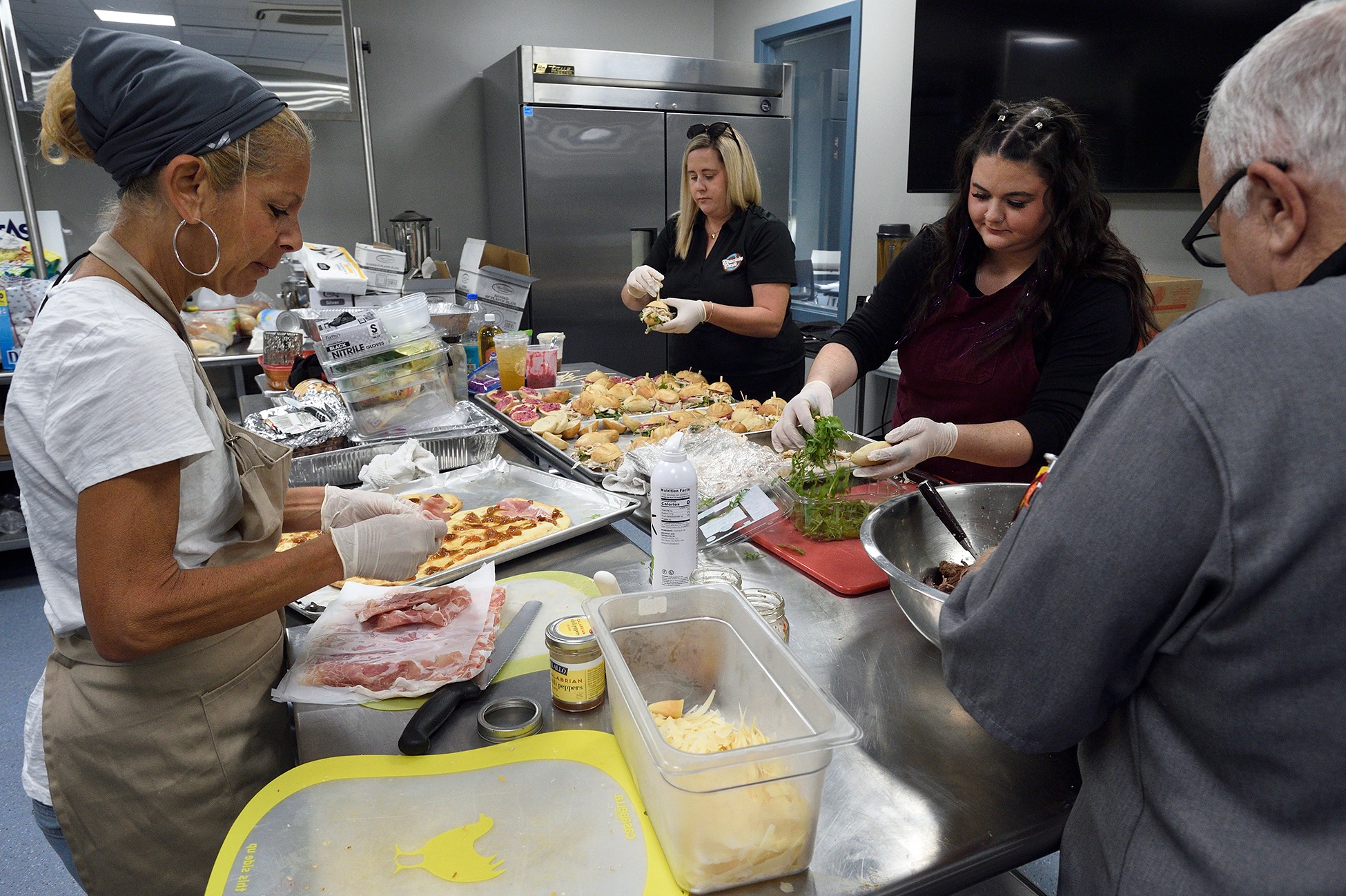
Starting a small food business just got easier in southern Delaware after county officials unveiled a new kitchen incubator to support “foodpreneurs” looking for a space to cook up their fusion of food blends.

Items now being produced at the centralized kitchen range from key lime pies to hot sauce, breads, and pizzas. The initiative is helping pave a new career pathway for residents in mostly rural Sussex County.

The county’s director of economic development Bill Pfaff identified the need for a commercial kitchen to help small businesses produce their goods.

“One of the things that I constantly heard from foodpreneurs was there wasn’t space for them to produce their product to take the commercialization because you must produce your food products in a licensed commercial kitchen,” Pfaff said.

The pandemic hindered the county’s efforts to get the kitchen up and running.

“I started working on this kitchen incubator pre-COVID, and then COVID hit, everything had to come to a standstill, but we never gave up, we continued to work on it,” he said. “It ended up taking a little bit more work to do because of the federal shutdown.”

After years of effort, the incubator was finally made available for use in a soft launch in late April, with two dozen food business owners currently utilizing the space. The grand opening attracted a wave of entrepreneurs eager to leverage this innovative resource.

Jessica Williamson of Milton was part of that first wave with Coastal Key Lime Pie, the company she co-owns. The creation of the kitchen incubator allowed Williamson and her husband Lee to bring their unique key lime pie to the coastal area.

Since discovering the incubator at Delaware Technical Community College’s Georgetown campus, the pastry chef says the demand for her pies has skyrocketed.

“We were the one of the first ones to sign up, this was back in May,” Williamson said. “That allowed us to quickly get our permit to be able to sell the pies at our local farmers market and we really [have] grown since then pretty amazingly … it was just hard to keep up [with] the demand.”

After working in human resources for more than 15 years, Williamson says she never imagined branching out into a new career. But with the foundation provided by the kitchen incubator, the couple now plans to open their own kitchen nearby.

“This is like a totally new industry for us to learn and grow in. I’ve done this my whole career and now I’m ready to try something new and venture out and see where it takes us,” she said. “We’ve already started plans for renovating our own space and having our own little small kitchen, which will be in Seaford.”

Pfaff says the incubator helps entrepreneurs deal with the big expense of starting a food-based business, including building a kitchen from scratch, providing their own kitchen tools, and doing maintenance.

“The purpose of the kitchen incubator was to help remove restrictive barriers of high cost capital investment associated with leasing or purchasing a commercial kitchen and kitchen equipment,” Pfaff said. “We’ve taken that headache out of the mix.”

“The kitchen incubator also reduces the risk of failure by removing additional startup barriers in areas of managing and maintaining a commercial kitchen,” he said. “We take care of everything.”

In addition to providing the kitchen to cook with, the county also offers resources needed to elevate the business.

“We also provide technical assistance in training and value-added services related to distribution, branding, marketing, pricing, insurance, legal services and financial opportunities,” he said. “When you go into business being a foodpreneur, being an entrepreneur, you’re working for the business. You want to get it to a point where the biggest business begins to work for you and we give you those tools to achieve that.”

To take advantage of this resource, individuals have to be in good standing with state permit requirements, obtain the ServSafe certification, and be insured. Afterwards individuals are able to pay for a membership to gain access to the kitchen.

After that, it’s up to them to bring the food and start cooking away.

This article was originally posted on the WHYY website at: https://whyy.org/articles/delaware-georgetown-kitchen-incubator-foodpreneurs/

Newsletter Sign Up

Stay Up To Date With Delaware

Continue reading

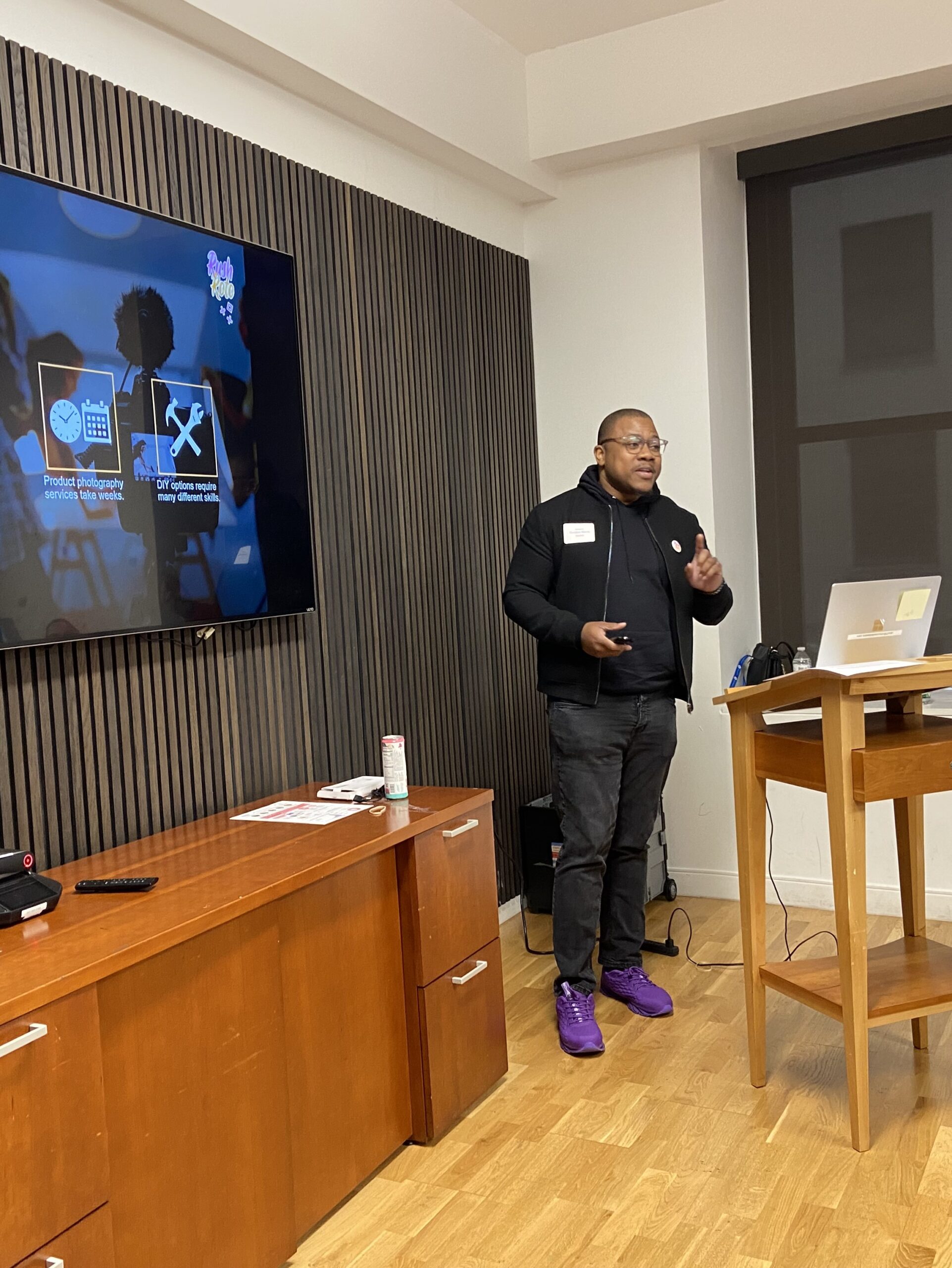
Christian Morris, Founder/CEO of Rush Roto

Christian Morris, Founder and CEO of Product Photo A.I. Firm Rush Roto

An Ongoing Series Highlighting Delaware Innovators


Christian Morris was working on a mixed-reality app that would allow users to view a musician or performer as if they were 3D in front of them and needed software that could cut the background out and leave just the subject. Despite a lukewarm response from people who reviewed it, he believed it had potential.

Enter his wife, who runs a successful Etsy shop but needed an inexpensive way to create product videos. With a few tweaks, the app helped propel her to the top 5 percent of sellers in six months. Morris saw small business owners – particularly ecommerce sellers – who don’t have large ad budgets for Facebook or Google but depend on their own social media posts to sell products as an untapped market for his artificial intelligence-based technology.

Rush Roto’s “simple and spectacular” AI technology doesn’t just add a background. It places the picture of an object into another image that can be turned into multiple campaigns in just a few seconds. That’s important for small businesses that rely on seasonal online selling and want to turn a single product photo into images for Halloween, the Christmas season, spring — or any other time or theme.

Morris put about $10,000 of his own money into getting the startup to the point where he could apply to business growth programs. He found early support in 2022 through Amazon Web Services (AWS), which selected Rush Roto as one of 25 startups for its inaugural AWS Black Impact Accelerator. The company won $125,000 in cash and $100,000 in Cloud Credits along with in-person training at Amazon headquarters.

Morris says the AWS program and Rush Roto’s recent selection into the prestigious Techstars Accelerator Powered by J.P. Morgan program – which included Rush Roto receiving a $120,000 equity stake – has opened a new world of possibilities in terms of venture capital funding, growth and connections. In addition, Rush Roto was a winner in Delaware Prosperity Partnership’s 2023 Startup302 competition, where it placed in the Delaware Tech-Enabled category.

“Success in programs like AWS, Techstars and Startup302 provide legitimacy and help us get our funding applications looked at, which can otherwise be very challenging,” Morris said.

Morris recently shared his views on innovation in Delaware and the path forward for innovators.

Why is Delaware a great state to be an innovator?

I know other Delaware founders have said it countless times, but our central location is key. Getting started with zero network connections in the tech world was challenging. However, I was able to expand my network at an exponential rate with just new tires, gas and determination. I joined startup communities in not only Delaware, but D.C., New York City and Philadelphia. I was usually the only Delaware resident in the room. That made me even more memorable.

I just did another pitch competition where I came in second in New York just a few months ago. And another one where I was going down to D.C., so there’s a plus at being able to hit multiple cities without having to hop on a plane. I also save money by not needing to rent cars and purchase hotel rooms in those states. In other words, being here also extended my company’s runway.

Last and most important is the real effort to support innovators here. After being a finalist in the Start-up302 competition, we received a letter from Delaware Governor John Carney. I don’t know if any founder I’ve met can say their state cares about what they’re doing at that high of a level.

What qualities should a successful innovator have?

Number one, by a large margin, is grit. Startup life is difficult. It will almost always take longer and be more challenging than you expect. “Unfair” is the default setting. You must learn to make peace with it, and then make your own luck.

Number two, focus. Focusing on the “why,” not the “what.”

Three, vision. You need vision to shift your “how” and “when” if needed. The reason you took action should be your north star. It’s easy to get caught up in your solution and forget.

What advice would you give innovators just starting?

When you get started, one of the most important things is to pick an idea worth pursuing by you. Not just one that is worth pursuing. You should have a true passion for the idea, not just potential profits. Those profits don’t leave the “potential” stage with most startups. You need to have a love for the why. Rush Roto’s why is serving underfunded entrepreneurs. I founded Rush Roto with the goal of using AI to make photography affordable to all businesses, to give time and resources back to the struggling solopreneur. Seeing Rush Roto do that gives me the energy to push through those tough days.

Newsletter Sign Up

Stay Up To Date With Delaware

Continue reading

DE Helps Region Earn Tech Hub Status

Delaware Part of Greater Philadelphia Region Precision Medicine Tech Hub Designated by Biden-Harris Administration

Image by macrovector on Freepik

Area is one of 31 selected from nearly 400 applicants, is identified as ‘primed for technological innovation and job creation’ under President’s Investing in America agenda


WASHINGTON, DC — The Biden-Harris administration, through the U.S. Department of Commerce’s Economic Development Administration (EDA), today announced the designation of 31 Tech Hubs in regions across the country, including the Greater Philadelphia Region Precision Medicine Tech hub encompassing Delaware, New Jersey and Pennsylvania

This is the first phase of the new Tech Hubs program, which is an economic development initiative designed to drive regional innovation and job creation by strengthening a region’s capacity to manufacture, commercialize and deploy technology that will advance American competitiveness. The program invests directly in burgeoning, high-potential U.S. regions and aims to transform them into globally competitive innovation centers.

The Greater Philadelphia Region Precision Medicine Tech Hub, led by the Ben Franklin Technology Partners of Southeastern PA, aims to become a global leader in end-to-end precision medicine. This Tech Hub will leverage the region’s density of life sciences assets and research and development expertise to weave together disparate technology applications: biotechnology, medical technology, genomics, synthetic biology supported by artificial intelligence, machine learning, robotics and more. Together, these tech-enabled efforts will deliver new ways to diagnose, prevent and treat disease, increasing evidence-based technology applications that improve morbidity and mortality and decrease health disparities.

Tech Hubs was authorized by the bipartisan CHIPS and Science Act, a key part of President Biden’s Investing in America agenda, which he signed into law in August 2022. Winners are located across 32 states and Puerto Rico and represent a cross-section of urban and rural regions. Designation is an endorsement of the region’s plans to supercharge their respective technological industries to create jobs, strengthen U.S. competitiveness and protect national security. The Tech Hubs focus on industries ranging from autonomous systems, quantum computing, biotechnology, precision medicine, clean energy advancement, semiconductor manufacturing and more, and they highlight how the Biden-Harris Administration is investing in innovation and economic growth in every region of the United States.

The Phase 1 winners were selected from nearly 400 applications from regional consortia that include industry, academia, state and local governments, economic development organizations, and labor and workforce partners. As part of the Tech Hubs competition, each consortium outlined plans for strengthening its region’s capacity to manufacture, commercialize and deploy critical technologies.

These designated Tech Hubs may now apply to receive between $40 million and $70 million each for implementation funding, totaling nearly $500 million.

Read the full Tech Hubs announcement release here.

Read more about the Tech Hubs program here.

Newsletter Sign Up

Stay Up To Date With Delaware

Continue reading

RiKarbon Chooses to Grow in Delaware

Homegrown environmental solutions firm RiKarbon chooses to continue growing in Newark, Delaware

Expansion of early-stage business focusing on carbon capture and utilization includes quadrupling lab space and creating 12 new full-time Delaware jobs


WILMINGTON, Del. (October 23, 2023) – RiKarbon Inc., an early-stage company specializing in developing innovative technologies for carbon capture and utilization, has chosen to continue growing in its hometown of Newark, Delaware, with an expansion from its Delaware Technology Park incubator space to nearby Delaware Industrial Park.

RiKarbon was founded in 2018 with support from a federal Small Business Innovation Research Grant from the Department of Energy and a mission to develop and commercialize sustainable proprietary technologies that capture and repurpose carbon emissions. The company has grown steadily since then, winning a 2019 Tech Connect Innovation Award, receiving several Delaware Technology Innovation Program Grants and outgrowing its 600 square feet of laboratory space in the startup incubator of Delaware Technology Park.

To maintain the momentum of its growth so far, RiKarbon will renovate and fit out 2,540 square feet of new chemical research and development lab space in a former electronic device manufacturing facility on Dawson Drive in Delaware Industrial Park. The company also will add 12 full-time positions to its current roster of six full-time employees and two part-time employees.

“We’re pleased that RiKarbon Inc. – a recognized leader in carbon capture – has chosen to expand in Delaware,” said Governor John Carney. “The company that started in a Delaware Technology Park incubator space will quadruple its square footage and add full-time jobs to continue to make Delaware a leader in the environmental space.”

The larger facility and staff will allow RiKarbon to continue its commercial scaleup of 100% bio-based oils for emollients to formulate personal care products, bio-poly-alpha-olefin base oils for performance lubricants, products for upcycled plastics manufacturing and other cost-competitive offerings for domestic and international markets. A recently announced partnership with BASF – the world’s largest chemical producer – includes bringing one of its emollient products to market by 2024. The company also has received letters of intent from global customers to deliver products and is now raising investment funding to do so.

“Congratulations to Delaware’s own RiKarbon, born right here in the First State, on their continued growth in the field of carbon capture,” said New Castle County Executive Matt Meyer. “It’s with great pride that we can say this company was incubated right here in Newark and has chosen to continue to expand where the talent lies, right here in Delaware.”

Delaware Prosperity Partnership supported RiKarbon’s request to the Council on Development Finance for a Graduated Lab Space Grant of up to $34,000 and a Jobs Performance Grant of up to $26,000 from the Delaware Strategic Fund. Distribution of these grants is dependent upon the company meeting commitments as outlined to the CDF, which reviewed and approved RiKarbon’s request.

“We are recreating similar ingredients that we use every day in our shampoo, conditioner, facial products or automotive engines, but making them in a socially responsible way from organic wastes that are causing environmental challenges globally,” said Basudeb Saha, president and CEO, RiKarbon. “It is very satisfying that we are able to deliver green and upcycled products to our customers to promote health and environmental efficacy while tackling climate challenges.”

###

About Delaware Prosperity Partnership

Created in 2017, Delaware Prosperity Partnership (choosedelaware.com) is the nonprofit public/private organization that leads Delaware’s statewide economic development efforts to attract, grow and retain businesses; build a stronger entrepreneurial and innovation ecosystem; and support private employers in identifying, recruiting and developing talent.

About RiKarbon

RiKarbon (rikarbon.com) develops technologies for cost-competitive renewable products that use non-conventional and typically unused carbon feedstocks to serve the domestic and international specialty and performance chemicals market.

Newsletter Sign Up

Stay Up To Date With Delaware

Continue reading

$750M Grant Funds DE/PA/NJ Hydrogen Hub

Mid-Atlantic Clean Hydrogen Hub Wins $750 Million Federal Grant

Delaware/Pennsylvania/New Jersey Clean Energy Collaboration Will Bring 10,000 New Jobs to Region


The Mid-Atlantic Clean Hydrogen Hub (MACH2) has been approved for $750 million in funding from the U.S. Department of Energy Regional Clean Hydrogen Hubs Program – one of just seven hubs so funded nationwide.

MACH2 aims to reduce pollution – particularly for frontline communities experiencing the “first and worst” environmental consequences – and advance clean energy. With a network of hydrogen producers, consumers and infrastructure throughout Delaware, Southeastern Pennsylvania and South Jersey, MACH2 will create more than 10,000 jobs in the production, delivery and use of zero-emission green and pink hydrogen for industrial, transportation and agricultural uses. It also will further Delaware’s prominence in the clean energy economy.

According to Delaware Governor John Carney, who co-chairs the Delaware Prosperity Partnership (DPP) Board of Directors, Delaware companies and institutions already have led on hydrogen and now will play a key role in this initiative.

Photo illustration by David Barczak

“This is a big deal,” Carney said. “Hydrogen is a clean fuel of the future, one of the ways we can pollute less. Our region has been chosen for a federal infusion of hundreds of millions of dollars that will create thousands of jobs and show how hydrogen can be made, transported and used in a real-world way. When we have talked about the opportunities for Delaware from the Bipartisan Infrastructure Law championed by President Biden and our Congressional delegation, this has been one of the big ones, and we got it. I’m looking forward to getting to work with our partners in the region.”

Dora Cheatham and the Delaware Sustainable Chemistry Association (DESCA) were among the critical organizations that spearheaded development of the winning proposal and public-private regional collaboration structures. Delaware partners – including DPP – worked alongside entities in Southeastern Pennsylvania and South Jersey on this winning plan. DPP, a proud member of the MACH2 collective, was able to financially support the more than year-long process that will have a substantive impact in Delaware and region for years to come. The October 13 announcement is another milestone in furthering DPP’s mission of advancing prosperity for all Delawareans.

“The exciting news coming from the Department of Energy about MACH2’s selection as one of our nation’s hydrogen hubs is great for the region and tremendous for the State of Delaware,” said CSC President and CEO Rod Ward, who co-chairs the DPP Board with Governor Carney. “DPP’s investment in the initiative made a lot of sense at the onset of the process. That forethought will help advance our region’s economic and environmental goals, positively impact families who live in environmentally challenged neighborhoods and provide more well-paying jobs for individuals who are part of our state’s workforce.”

The White House release about the grant awards is here

Additional details about MACH2 are here

An article about the University of Delaware’s role in the initiative is here

Newsletter Sign Up

Stay Up To Date With Delaware

Continue reading

Liam Fitzgerald, Co-Founder of Connect2Co

Liam Fitzgerald, Co-Founder of Digital Workspace Firm Connect2Co

An Ongoing Series Highlighting Delaware Innovators


Liam Fitzgerald believes many businesses have a lack of cross-departmental clarity, an inability for executives to make strategic decisions and a lack of overall workplace morale. This belief led to the creation – with co-founder Robbie Parisius – of Connect2Co, which describes itself as “the future of productive work.”

“As a founder, my objective is to improve communication and collaboration, implement sustainable practices into companies of all sizes and drastically improve scalability in startups for fellow founders to reach their goals more effectively,” says Fitzgerald, whose company vision is to “transform the digital workspace into something that is engaging and meaningful, data-driven and efficient.”

Connect2Co won a 2023 $100,000 Encouraging Development, Growth & Expansion (EDGE) Grant from the Delaware Division of Small Business to support the growth of a business-to-business platform that enables businesses of all sizes to manage, optimize and collaborate with other companies. The tool essentially enables customers to operate a digital workspace from one central location, eliminating the need for toggling between various applications such as Gmail, Google Drive, Microsoft OneDrive and Salesforce.

Fitzgerald spoke to Delaware Prosperity Partnership about his views on innovation in Delaware and his advice to hungry innovators.

Why is Delaware a great state to be an innovator?

Delaware’s ecosystem of entrepreneurs and business professionals – and government entities driven by their ability to support small businesses and systems by providing access to vital resources and people – make Delaware a “Goldilocks zone” for innovation and innovators alike. Small businesses account for more than 98% of the businesses in Delaware, employing over 55% of the workforce. This supports the obvious presence of a breeding ground for entrepreneurs to provide value to each other in a multitude of ways.

In your view, what qualities should a successful innovator have?

  • Successful innovators have core qualities that define their success:

  • Understanding in the form of malleability. The presence of individual identity should not supersede an entrepreneur’s ability to listen to others in relation to feedback, criticism and support. Innovators must be sure in their mission and overarching objective but must simultaneously be willing to change course and pivot as their business or venture progresses. Communication and understanding are vital to improvement. Even if feedback is not used, shared perspectives give clarity to beautiful ideas and ventures.

  • Innovators must be leaders. Successful entrepreneurs and thinkers have different personality types. Some can lead in a school of thought, industry or field. Some are great managers who can realize the dormant abilities of their team and empower them to excel personally and within their organization. Some lack these qualities, but lead in their relentless persistence, drive and hunger to solve problems and create/offer solutions. Ideally all three leadership qualities should be evident in the perfect leader, but the third quality (persistence) will inevitably allow them to penetrate the market and achieve the other two qualities.

  • Innovators must have ideas or systems that are better than those that previously existed. This may be evident in the form of improvement to solutions, products and systems that already exist; innovative and cutting-edge solutions/products or services that do not exist; or the enablement of team members to realize their full potential and, in turn, bring their ideas to light. The ability to execute on these ideas is what differentiates thinkers from doers.

What advice would you give innovators just starting?

  • Understand your why, then your what, then your how. Figure out your purpose for your venture, then what you will offer and then dissect how you will fulfill what you will offer.

  • Plan with the objective to execute. You can write business plans, forecast your expenses and your revenue, create feasibility analysis and research statistics on your market, industry and customers, but nothing will come close to talking to your target customers. If I analyze what I did wrong and right, I can truly say that the best practice is to find an idea, talk to people you trust to establish preliminary validity of the idea, build part of the idea and start showing it to these people and getting users to test it.

  • Rinse and repeat this process incrementally, and your idea will grow into a tangible thing. Your customer/communication base will also increase. Creating or building something people want enables you to figure out if an idea is worth pursuing. This should be done in a way that the person/group you are targeting is so compelled by the product that their want becomes a need. Turning wants into needs creates urgency and encourages retention. This, however, depends highly on the target market and customer segment you are selling to. Luxury goods are attractive due to their exclusivity and scarcity – taking advantage of the want factor. Commodity goods like toothpaste and soap are attractive due to their necessity. Services offered, solutions developed or products created, however, can initially be something the consumer wants that, after use, makes them realize they need it (such as iPhone, Gmail, CRM Systems).

Newsletter Sign Up

Stay Up To Date With Delaware

Continue reading

DE Project Wins $3.2M NIH IDeA Grant

National Institutes of Health awards iRED University project $3.2 million IDeA Grant

Photo Illustration by Jeffrey C. Chase/University of Delaware

DESCA, University of Delaware and InsiteHub partnership will use funding to advance biomedical entrepreneurship in Delaware


WILMINGTON, Delaware – On August 21, 2023, the National Institutes of Health (NIH) awarded a grant through the IDeA Program to iRED University – a new collaboration between DESCA, the University of Delaware and InsiteHub – that will deliver an online entrepreneurial curriculum geared to early-stage innovators and startups that will help them identify their most viable applications as early as possible and subsequently connect them to the broader innovation and mentoring ecosystem. The program is funded through a three-year grant totalling up to $3.2 million, of which more than $980,000 will be directed to DESCA. The Small Business Technology Transfer (STTR) grant is now in Phase I, with follow-on funding expected in Phase II.

According to the National Science Board 2018 Science & Engineering Indicators, university invention disclosures totaled 22,507 in 2015 (compared to 13,718 in 2003) and patent applications almost doubled over the same period. In 2016 alone, over 6,600 patents in chemistry and the sciences were awarded – yet many of these patents never realize their full commercial value. iRED University aims to change that.

The iRED University team is working on a simple premise: in order to increase the number of patents and innovations commercialized, we need to increase the funnel of viable technology startups at the front end, and in order to do that we need to meet the very specific and unique needs of technology driven innovators. iRED University will be delivered through a rigorous and engaging online curriculum that will be critical to supporting the project goals and bridging the gap of sufficient training and knowledge for innovators in the biomedical field through a high-availability on-demand learner experience platform. The curriculum will lead innovators from ideation, identifying market gaps, to execution of a product strategy that translates customer requirements into effective commercial execution of new products. The platform will also provide the ability to assess participants at the point of registration and allow them to develop and access a personalized curriculum that can be customized for their specific gaps. This helps both new and experienced innovators to focus on areas of need and provide direct learning interventions.

The product will be initially launched in Delaware and will be open to the entire Northeast when launched. The National Institutes of Health (NIH) established the IDeA (Institutional Development Award) Program in 1993 to broaden the geographic distribution of NIH funding and enhance competitiveness for funding in states with historically low NIH funding. The states that fall within the Northeast Region besides Delaware include Maine, Vermont, New Hampshire and Rhode Island. Other regions include the Southeast Region (West Virginia, Kentucky, South Carolina, Puerto Rico, Missouri), Central Region (North & South Dakota, Nebraska, Kansas, Omaha) and the Western Region (Montana, Wyoming, Idaho, Nevada, New Mexico, Alaska, Hawaii).

The core team for this new partnership includes Dr. Julius Korley, Associate VP UD Office of Economic Innovation & Partnerships (OEIP), Louis DiNetta, Technology Business Development Manager Delaware Small Business Development Center SBDC, John Royer, CEO, Insite Hub, and Dora Cheatham, Executive Director, DESCA, and combines expertise in technology development and commercialization, online curriculum development and execution, business development and new product commercialization and SBIR/STTR expertise.

About DESCA

Formed in 2010, the mission of DESCA is to enable science innovators commercialize their technologies faster, as well as driving the new legacy of ChemTech. Today, DESCA has 3 key areas of focus around which it builds its programming:

    • Driving innovation and collaborative partnerships between major strategics, startups and universities;
    • Convening industry leaders in the public and private sectors on emerging issues and driving adoption of emerging trends & technologies that will be the key drivers of sustainability for the future;
    • Connecting students to industry and vice versa, with a goal of harmonizing the development of talent with the validated needs of industry.

    About OEIP

    The Office of Economic Innovations and Partnerships brings together the collective and integrated resources of the University of Delaware and the State’s business, academic and entrepreneurial communities to achieve new levels of innovation and economic development. The Office strives to:

    • Be the partner of choice in matters of economic development, commercialization of innovation, entrepreneurship and building businesses;
    • Enable entrepreneurs and innovators to accelerate ideas into the marketplace, grow businesses and form partnerships through access to University assets, space, capital, counsel and connections;
    • Deliver a unique, integrated model centered on long term, productive partnerships.
    • Support the University, state and region’s entrepreneurial, technical and business communities to reach new levels of economic development.
    • Create a culture where ideas and innovation thrive.

      About INSITE HUB

      • InsiteHub has been a provider of learning technology, medical education, and product training to the life science and medical device industries for over 10 years. InsiteHub has established itself as a leader by developing innovative learning technology solutions and earning key industry awards for application design and impact. In addition, InsiteHub’s platform was featured in an extensive Department of Education grant focused on researching student engagement at the university level. InsiteHubs’s instructional design paradigm is based on the ADDIE model whose steps include Analysis, Design, Development, Implementation, and Evaluation.

      About Delaware SBDC

      • For over 35 years, the “T” accredited DSBDC has assisted Delaware’s small businesses through information, counseling, and education. DSBDC’s technical assistance has resulted in more than 1,500+ new business starts, 4,200+ new jobs created (since inception), and $267M capital raised (since 2010). In 2009, DSBDC became only the eighth SBDC accredited as a “technology” designated program after demonstrating significant efforts to target and support Delaware’s technology-based businesses as well as its pivotal role as an essential connector and resource within the state’s entrepreneurial and technology ecosystems.

      This article was originally posted on the Delaware Sustainable Chemistry Alliance website at: https://desca.net/f/desca-ud-insite-hub-win-3m-grant-to-advance-entrepreneurship

      Newsletter Sign Up

      Stay Up To Date With Delaware

      Continue reading

      Patrick Callahan of LabWare

      Entrepreneur Patrick Callahan, Head of Data and Analytics for LabWare

      An Ongoing Series Highlighting Delaware Innovators


      LabWare’s acquisition of Patrick Callahan’s CompassRed data analytics firm in February 2022 started with a chance first encounter between Callahan and LabWare President and CEO Vance Kershner and Callahan at Buckley’s Tavern in Centreville.

      “Developing a relationship with Vance is the perfect example of things that happen in Delaware that just don’t happen anywhere else, in my opinion,” Callahan said. “We met over a bar stool.”

      Callahan built CompassRed into a visionary company in machine learning and predictive analytics. As head of data and analytics at LabWare, he is now developing a dedicated advanced data analytic arm as part of efforts to elevate the company’s position as the global leader in the laboratory information management market.

      Previously, the Drexel University and Widener School of Law graduate was a founding partner of The Archer Group. The award-winning, interactive internet marketing firm, founded in 2003, serves a diverse roster of clients in the financial services, retail, pharmaceutical and entertainment industries – including numerous Fortune 500 clients.

      Callahan also serves on the boards of several Delaware organizations. These include the Delaware Data Innovation Lab, the Pete du Pont Freedom Foundation, Girls on the Run and Delaware Prosperity Partnership.

      He spoke with DPP about innovation in Delaware and what it takes to innovate successfully.

      Why is Delaware a great state to be an innovator?

      I’m sure we’ve heard this a million times, but the accessibility to me is the big thing. If you’re looking to be in one of the best labs or chemical spaces, you can drive 40 feet and find people who are customers, thinkers, funders and legislators. There’s a reason why we have the biggest banking, biggest chemical companies and a lot of the other things right here in the Northeast corridor. When people talk about what made the country great, you can see that diversity here in the state – socioeconomic levels, education levels, diversity of thoughts and backgrounds.

      How I met Vance is a great example. You couldn’t just go to San Francisco and get a meeting with founders like Reid Hoffman (LinkedIn), Mark Zuckerberg (Facebook) or Marc Andreessen (Mosaic, Netscape). You just don’t go to a restaurant, introduce yourself and then strike up a conversation there. That’s unheard of.

      In your view, what qualities should a successful innovator have?

      I think humility is one thing. If you’re humble, that means you’re always learning, you’re always trying to figure out things, and you’re always knowing you don’t have the answer. People who say, “I know the answer,” are the ones who nine times out of 10, don’t. Getting out there and meeting people is very, very important if you want to sell your product or address the problem that you’re trying to address. That could be over Zoom or in person, but curiosity about another person’s view and experiences is just so important. Expanding what we’re doing at LabWare requires me to get to know the customers in the labs and the end user of the product.

      Intellectual curiosity and the willingness to listen to someone no matter how different they are is something you can learn and build into your product and innovate.

      You can do that over Zoom. We’ve shown over the last two years that’s essential, and maybe even easier. Before COVID, we’d have meetups where only 30 or 40 people would show up in person. But during COVID, we’d get hundreds of people from all around the world, which would lead to follow-up calls. I don’t know if we’ll go back. We want to have a mixture of both because there are things you can learn on the side before the meeting.

      What advice would you give an innovator who’s just starting?

      First, go meet people, go to these meetups. Many are free, but I find myself asking if someone will spend $1 on it. To me, that is a good qualifier because if you give it to them for free, they won’t necessarily assign value to it. When we were doing these meetups, people would sign up but two-thirds of them wouldn’t show up. The minute we started charging $5 and giving the money away to a nonprofit, really engaged people showed up because they thought of it as value. If you’re providing value, you should get value back for it. It’s not just time.

      Second, follow your interest. Doing good is good for business. I feel passionate about Girls on the Run, but speaking at a networking event also landed Archer one of our largest clients. Don’t go into it thinking you’re going to get something out of it. Be genuine, but give back to the community – and encourage your team to do the same — and I’ll tell you, you’ll get it back tenfold. There are so many nonprofits in Delaware that do so many good things that you’ll meet your next customer, hear about the next important problem that you can help solve or just meet someone with a different perspective that will help you back at the office.

      Newsletter Sign Up

      Stay Up To Date With Delaware

      Continue reading

      10 DE Companies Win Latest EDGE Grants

      10 Delaware Companies Win Latest EDGE Grants

      Division of Small Business Encouraging Development, Growth and Expansion awards have now provided more than $5M in funding to businesses statewide


      DOVER, Del. – The Delaware Division of Small Business has recognized 10 small businesses as winners of the seventh round of the Encouraging Development, Growth and Expansion (EDGE) competition. Awardees in the latest round of the competition include a drone company in need of an indoor facility, a company developing a new product for next generation silicon solar cells and owners looking to bring a printing and artist co-working space to Kent County.

      Governor John Carney, Deputy Secretary Kristopher Knight and Division of Small Business Director Regina Mitchell announced the companies at an event at Chase Field House in Wilmington, where Hx Innovations, one of this round’s winners in the STEM category, is located.

      “The EDGE grant program helps small businesses get the ‘edge’ they need to expand and innovate by providing much-needed capital assistance that these businesses may not have access to otherwise,” said Governor Carney. “This program has been very successful over the last few years, and we look forward to seeing how these companies and business owners grow their businesses with their grants.”

      “Small businesses in Delaware are job creators, innovators, help create economic diversity and reduce environmental impacts,” said Deputy Secretary of State Kristopher Knight. “The EDGE grants are driven by creativity and innovation – which is reflected by the diverse array of entrepreneurs and STEM-related businesses this round. With the help of the EDGE grants, we are fostering innovation with the necessary capital to help individuals start or expand their small business.”

      Businesses that are less than seven years old and employ no more than 10 staff are eligible to apply for an EDGE grant. The grants are awarded through a competitive selection process. After thorough internal review, 16 finalists pitch their proposals to an outside expert panel of judges. From there, 10 companies are selected for awards. Five STEM-based companies each receive up to $100,000 for eligible expenses while five Entrepreneur Class (non-STEM) businesses each receive up to $50,000.

      “The EDGE competition allows our Division to support small business owners in Delaware who are making significant scientific advancements, creating unique products and helping strengthen their local communities,” said Division of Small Business Director Regina Mitchell. “We are really pleased with the quality of applications received. For the next round, which will open September 1, we are working to increase the number of STEM applications we get, particularly from Kent and Sussex counties.”

      EDGE is a matching grant program. The Division of Small Business matches a winning business’s investment on a 3-to-1 basis. The business can spend EDGE grant funds on expenses that help improve the company’s long-term chances of success, such as a marketing campaign to help acquire more customers or purchasing a needed piece of equipment that can increase production capacity.

      Including this round, $5 million has been awarded to 80 promising Delaware small businesses since EDGE was first launched in 2019. Industries represented have ranged from wearable medical devices to farming to restaurants.

      This is the seventh round of funding for the program. Approximately 130 businesses applied in March, and 16 finalists gave public presentations in May at Delaware State University. From those, the following recipients were selected:

      Stem Class

      Connect2Co Inc. (Wilmington)
      Connect2Co is a cutting-edge business-to-business startup software tool that will revolutionize the digital workspace for businesses and organizations of all sizes. Its all-in-one platform seamlessly integrates external solutions, eliminating the need for toggling between various applications (For example, send an email with Gmail, download or share a document from Google Drive/Microsoft OneDrive, close an opportunity with Salesforce). The grant money enables Connect2Co to ramp up its initial operations by funding co-working space at The Mill in Wilmington, along with marketing and speeding the platform’s development timeline.

      Doubly LLC (Middletown)
      Doubly is a minority- and women-owned startup founded in 2023. Doubly is an innovative application that integrates seamlessly with enterprise messaging platforms like Teams and Slack to help boost productivity and connectedness as a result of remote work conditions. EDGE funding will be used to finalize the application’s development and conduct extensive user testing as well as hire software engineers and designers to expedite the application’s development.

      TX Electromagnetic Materials LLC (Wilmington)
      TX ElectroMagnetic Materials LLC is a science-driven company committed to advancing the development of cutting-edge electro and magnetic materials for the solar cell and semiconductor industries. The company is developing a new metallization silver paste specifically designed for future silicon solar cells. The EDGE Grant will be used to accelerate product development efforts, expand sales and marketing initiatives, develop product samples and successfully bring the product to market.

      Hx Innovations (Wilmington)
      Hx Innovations is a biomechanics testing and technology company with a patented assessment technique related to the stability and joint movement of the knee, ankle and foot. This led them to develop a neuromuscular predictive model for sports teams to help them create safe training regimens and recovery strategies for athletes. Hx Innovations is currently located in Chase Field House and is using its technology with athletic teams there. The EDGE funding will be used to expand the company’s presence at the Fieldhouse, build a more robust database for its platform and make the software for real-time injury monitoring mobile.

      Leadership Excellence Academy for Nonprofits (Wilmington)
      Leadership Excellence Academy for Nonprofits (LEAN) aims to make a transformational impact in the nonprofit sector. Instead of focusing on short-term gains, LEAN adopts a long-term approach to prioritize creating sustainable solutions. LEAN’s expertise helps nonprofits identify and address gaps in their operations, thereby making them more effective in achieving their goals. EDGE funding will be used to develop innovative app technology to provide a vehicle for encouraging next-gen donors to support nonprofits through giving.
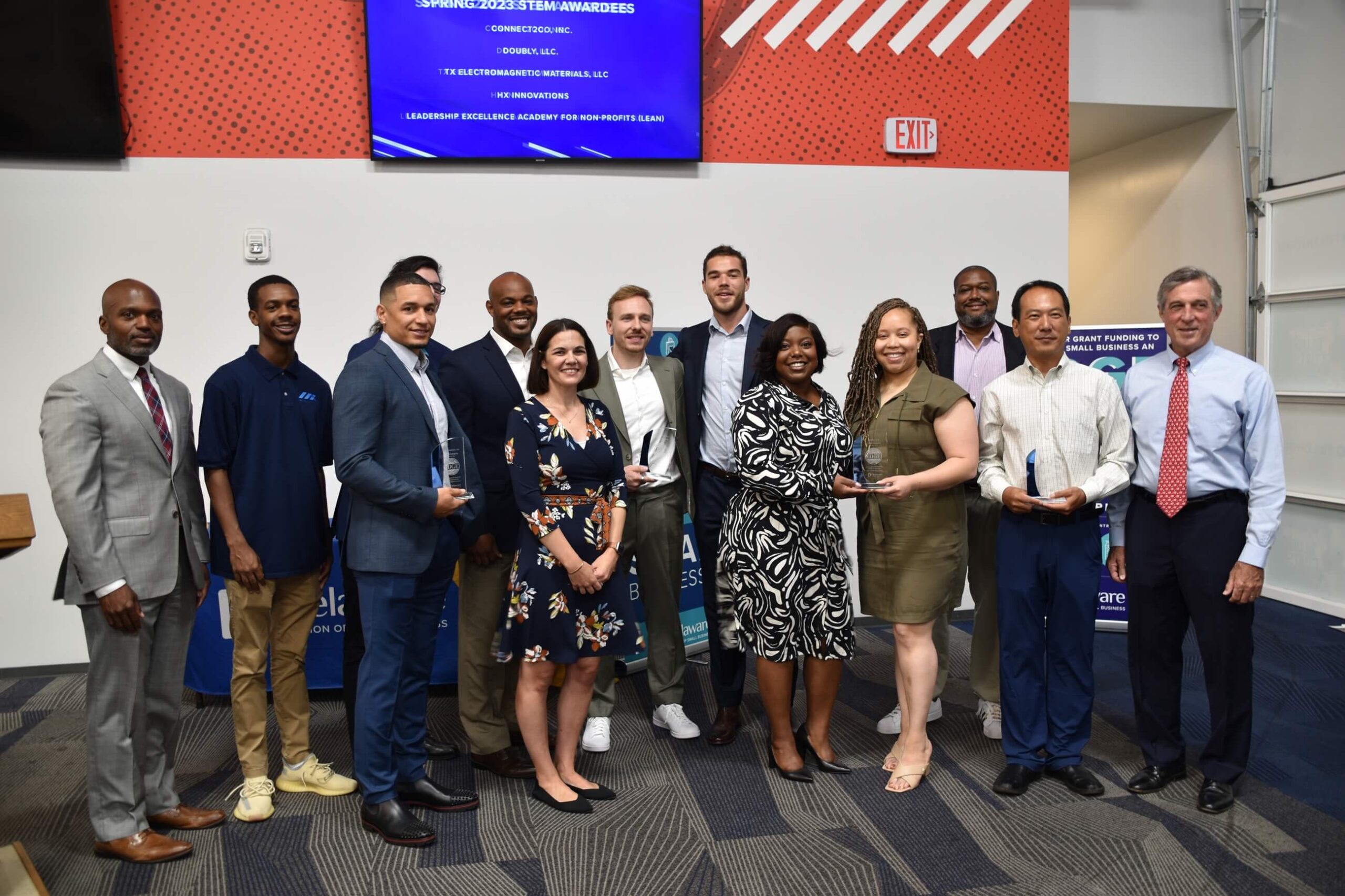
      Group photo of STEM Category EDGE Spring 2023 Winners

      Spring 2023 EDGE Entrepreneur Category Winners

      Entrepreneur Class

      Droneversity LLC (Wilmington)
      Droneversity hopes to revolutionize the aviation and STEM industries through comprehensive drone-related workforce development programs. A diverse range of offerings includes drone pilot ground and flight school for federal certification, STEMulation programs for hands-on education, international eSport drone soccer programs, professional development for educators and consulting services. EDGE funding will help secure a permanent indoor facility as opposed to temporary site hosts where internet connectivity and weather conditions can be challenging. The company’s planned location is in a downtown development zone.

      G & R Industries LLC (Smyrna)
      G & R Industries is a startup manufacturing company, located in Smyrna, that is bringing an innovative construction hanger to the market. The GRO Hanger provides a safer, faster, stronger and more cost-effective solution for installing piping and fixtures in steel joist construction. EDGE funding will support startup costs, including the purchase of assembly equipment; trade show marketing; testing and certifications; and the initial production run of GRO Hangers.

      Paraklete Properties & Design LLC (Viola)
      Paraklete Properties is a woman-owned and family-operated business that seeks to provide locally grown baled pine straw. Established in 2019, Paraklete Properties is committed to Delaware’s growth while preserving its natural beauty. EDGE funding will be used to purchase a proprietary pine straw baler as well as to construct a storage location for the straw. The funds will assist in providing an increased volume of densely packed pine bales, with minimally handled straw, as well as provide a protected area for storage before sale.

      The Nest Play Cafe (Middletown)
      The Nest Play Cafe is an innovative establishment for parents to take their young children, to explore a fun, exciting play area while they relax or interact with other parents in an upscale café lounge and seating area. With a holistic, eco-friendly and Montessori-inspired approach, The Nest Play Café offers programming, including baby sign language; Spanish; Mandarin; sensory play; arts and crafts; and milestone development classes taught by a pediatric occupational therapist. EDGE funding will enable to owners to do Phase 2 of their construction plan for an additional restroom, add plumbing and buy equipment for an organic coffee and smoothie bar area.

      Studio B (Harrington)
      Studio B seeks to establish a unique fusion of commerce and art by serving as an ultra-fast turnaround print-on-demand hub and a supportive community workspace. The company will offer convenient access to top-notch print work such as restaurant menus, business cards, flyers, banners and more. Additionally, Studio B will extend its services to artists and individuals, providing access to professional assistance, a supportive creative environment and high-end tools and equipment that are typically out of reach for independent creators. EDGE funding will help the company acquire equipment and professional website assistance for effective outreach, marketing and online sales potential.

      This article was originally posted on the Delaware.gov website at: https://news.delaware.gov/2023/07/19/dsb-awards-edge-funding-to-10-de-companies/

      Newsletter Sign Up

      Stay Up To Date With Delaware

      Continue reading