Tag: Workforce

How the STAR Fund Helps STEM in Delaware

The STAR Fund and STEM in Delaware

If you’re a recent STEM graduate looking to launch your career in a place where innovation thrives and your work makes a difference, Delaware might be your perfect match.

Delaware offers an unbeatable mix of career opportunities, lifestyle, and community for STEM professionals. It’s home to a fast-growing life sciences sector, nationally ranked research institutions like University of Delaware, and a rich history of scientific discovery—think DuPont’s legacy, now expanded by leading companies like Agilent, Incyte, Solenis, and Prelude Therapeutics.

In Delaware, your commute is measured in minutes—not hours. You can live in a vibrant downtown, scenic suburbs, or near the beach — all while staying connected to the Northeast corridor’s major metro areas. Philadelphia, New York City, Washington D.C., and Baltimore are within a short train ride or drive, making Delaware a strategic home base for STEM professionals who want both access and balance.

And unlike many tech hubs, Delaware offers:

  • No sales tax and low personal tax burden (6th lowest in the country!)
  •  Lower cost of living compared to the Northeast and Mid-Atlantic region
  • A welcoming community where professionals can make a name for themselves
  • Easy access to outdoor recreation, including beaches, biking trails, and state parks
  • Vibrant arts, culture, and dining scenes, from Wilmington’s music festivals and theaters to historic small towns with acclaimed restaurants and local makers

Delaware doesn’t just attract talent — it invests in it.

Introducing the STAR Fund: Student Loan Assistance for STEM in Delaware

To help recent graduates build long-term careers in the First State, Delaware has launched the STEM Talent Advancement and Retention (STAR) Fund—a student loan repayment program that provides up to $6,000 to STEM professionals working in high-demand fields.

The fund, administered by the Delaware Division of Small Business in partnership with BioConnect DE, is part of the state’s commitment to growing a skilled, inclusive, and future-focused workforce.

Who is Eligible?

The STAR Fund is open to individuals who:

  • Hold an associate, bachelor’s, or graduate degree in a STEM field from an accredited institution
  • Work full-time (35+ hours/week) for a Delaware-based employer

Are employed in one of the following fields:

  • Life, natural, or environmental sciences
  • Computer information or software technology
  • Advanced mathematics or finance
  • Engineering
  • Medical device technology

Preference is given to those who live in Delaware or attended a Delaware college or university.

What You Can Receive

  • Depending on your degree, STAR Fund participants may receive:
  • Up to $1,000 for an associate degree
  • Up to $4,000 for a bachelor’s degree
  • Up to $6,000 for a graduate or post-graduate degree

Awards can be received for up to four consecutive years, provided they don’t exceed your actual loan expenses.

Your Future, Backed by Delaware

Whether you’re working in R&D, software development, biotech, or sustainable engineering, Delaware offers a connected community, growing opportunities, and meaningful support for those who want to make an impact.

The STAR Fund is more than a financial incentive — it’s a statement that Delaware values your work, your education, and your future. For full program details and application information visit bioconnectde.org/star-fund.

Newsletter Sign Up

Stay Up To Date With Delaware

Continue reading

UD-DSU Degree Grows Engineer Pipeline

UDel-Del State Dual-Degree Program Will Help Diversify Area’s Engineering Talent Pipeline

University of Delaware and Delaware State University faculty and staff with the first cohort of the UD-DSU Summer Engineering Research Experience.
Photo by Kathy F. Atkinson.

September 12, 2024

Enrollees Study a STEM Field for 3 Years at DSU, Then Attend UD for 2 Years to Complete Both Bachelor’s and Master’s Degrees in Engineering


By Jamie Washington

The 53 miles between the University of Delaware in Newark and Delaware State University in Dover feels a bit closer now for the first cohort of DSU students in the Summer Engineering Research Experience, which is part of the dual-degree engineering partnership at the two schools.

Jada Moore, a rising DSU junior majoring in engineering physics with a bioengineering concentration, is one of the seven students who participated in the 10-week program designed to help them connect with UD faculty and with each other.

“It’s really the best of both worlds,” said Moore, who initially planned to enter the workforce after earning her bachelor’s degree at the historically Black college/university (HBCU) but is now planning to add a graduate degree from UD. “DSU students interested in engineering and the HBCU experience can learn the basics of engineering at DSU and then drive about an hour away to get their master’s in engineering from UD.”

Students in the dual-degree program study a STEM field for three years at DSU, which does not offer an engineering major, then attend UD for two years to earn a bachelor’s and master’s in engineering, said Levi Thompson, the Elizabeth Inez Kelley professor chemical and biomolecular engineering, who helped launch the partnership in 2021 during his term as dean of the College of Engineering. The dual-degree program takes five years, while completing the two degrees separately would typically take at least six years.

“It is an enriching educational opportunity for DSU students to go beyond the fundamentals of engineering and a chance for both universities to add even more excellence to the engineering workforce in Delaware,” Thompson said.

Kim Isett, UD’s vice provost for academic programs and university initiatives, said the partnership itself reinforces the essential value of collaboration.

“Collaborative programs like this ensure student success and create a pool of well-qualified job applicants for the state of Delaware and beyond,” she said.

Before leaving DSU to finish their studies at UD, students will attend the Summer Engineering Research Experience at UD each summer.

“The Summer Engineering Research Experience is a valuable opportunity for students to continuously engage in master’s level research while building relationships within their cohort and becoming familiar with UD’s faculty and staff,” said Noelle-Erin Romero, the director of UD’s RISE program.

Students received individualized academic advising before enrolling in their required UD Summer Session course, which will transfer to DSU to fulfill their undergraduate requirements. They were also paired with a UD professor who served as their research mentor and assigned the research project that they would discuss at UD’s Undergraduate Research Symposium.

Each week students attended professional development workshops and program check-ins with UD leadership and engineering industry professionals.

“These were pivotal in preparing students for their future careers and provided them with opportunities to connect with leaders in their field and gain invaluable insight,” Romero said. “The relationships forged highlight the ongoing support of local companies and are leading to internships and opportunities for students to start building skills for future success.”

The students also engaged in social activities every other weekend to build camaraderie within their cohort, Romero said.

As the program develops, students will also have the opportunity to complete a summer internship, beginning in 2025. Over a dozen companies have expressed support and their shared interest in diversifying the engineering workforce in the state, said Tripp Shenton, associate dean for undergraduate education in the College of Engineering and professor of civil and environmental engineering.

“This program opens doors to high-impact careers, fosters a more diverse and inclusive workforce and strengthens Delaware’s innovation ecosystem,” said Cherese Winstead, dean of DSU’s College of Agriculture, Science and Technology and professor of chemistry as well as member of the Delaware Prosperity Partnership Board of Directors.

This article was originally posted on the University of Delaware website at https://www.udel.edu/udaily/2024/september/dual-degree-partnership-engineering-summer-program-delstate-hbcu/.

Newsletter Sign Up

Stay Up To Date With Delaware
Continue reading

Nurturing Talent: Delaware’s Initiatives in Education and Workforce Training

July 17, 2024

Delaware is making significant efforts to ensure a successful and skilled workforce for the future, engaging various stakeholders and organizations to continue strengthening the state’s vibrant and diverse labor pool. These efforts include the expansion of career and technical education programs through Delaware Pathways and the state’s vocational technical school districts, as well as specific workforce initiatives in STEM and the life sciences.

Delaware Career & Technical Education Opportunities


Delaware has been a pioneer in developing career and technical education programming through Delaware Pathways, a collaborative initiative involving communities, schools, and industry to bridge the gap between education and employment. With over 30,000 students enrolled in at least one pathway at 89 middle and high schools in 2023, Delaware Pathways gives students the opportunity to learn the fundamentals and explore their interests in a variety of industries, including agriscience, manufacturing, information technology, STEM, and more. Through job placements and other work-based learning experiences, students gain essential soft skills such as timeliness, professionalism, and career aspiration.

Additionally, Delaware’s vocational-technical (vo-tech) school districts play a critical role in preparing students for the workforce by offering specialized training and educational programs. Each county has its own vo-tech district. The vo-tech schools in Delaware are full-day, offering a typical high school experience complete with sports teams and prom. The vo-tech districts emphasize the direct connection between education and employment through co-ops and other job placement opportunities, setting a foundation for lifelong learning and career advancement. The vo-tech school districts also offer adult and continuing education coursework to the community.

While enrolled in Pathways or vo-tech schools, many students earn apprenticeship credits through coursework or dual enrollment in Delaware Technical Community College (DelTech), the statewide community college with campuses in each county. In addition to certificate and two-year degree offerings, DelTech has also established over 200 connected degree agreements, creating smooth transfer opportunities to four-year bachelor’s degrees programs. Through the SEED (Student Excellence Equals Degree) scholarship, Delawareans of all ages are eligible for free tuition at DelTech, greatly expanding access to higher wages and economic prosperity.

STEM & Life Sciences Workforce Diversity

Other key workforce development programs in Delaware focus specifically on the life sciences sector and STEM career pathways. Many of these programs aim to bolster the state’s STEM talent pool and promote diversity within these fields, such as Zip Code Wilmington. Zip Code Wilmington offers a 12-week coding bootcamp that teaches individuals of all ages and backgrounds the necessary skills to attain a high-demand software programming career. By building long-term, lasting relationships with tech companies and creating a highly-skilled talent pipeline, Zip Code Wilmington aims to lift the community in the greater Wilmington area and support economic growth.

Additionally, the recently announced Delaware Center for Life Science Education and Training will partner with industry, educators, and government to address the demand for a skilled life science workforce through recruitment and training efforts. Expected to open in early 2025 in downtown Wilmington at the Chemours STEM Hub, the Center has initial funding of $3 million for a three-year pilot program to train individuals of all ages in basic laboratory and biomanufacturing skills. As Delaware’s life sciences sector continues to drive economic growth in the state and region, this initiative represents a significant partnership between education, industry and government, ensuring Delawareans of all backgrounds will have access to good jobs in a growing field.

A Skilled & Competent Workforce is Necessary for Economic Growth

Through these initiatives along with many others, Delaware is not only preparing its youth for the challenges of the future through career education and training, but also fostering an environment where businesses can thrive with a skilled and competent workforce. By starting career education early, expanding vocational training and tuition-free adult education, and promoting diversity and continued education in STEM and the life sciences, Delaware is setting a model for other states to follow in workforce development.

Newsletter Sign Up

Stay Up To Date With Delaware
Continue reading

UD Hosts SABRE Center Groundbreaking

Focused on the Future

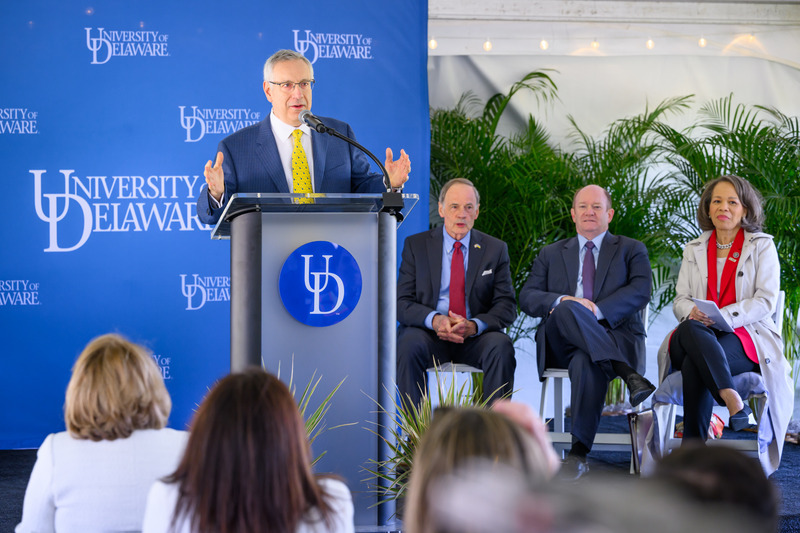
University of Delaware leadership, members of the UD Board of Trustees and elected officials break ground for the SABRE Center on UD’s STAR Campus.

UD marks milestone with SABRE Center groundbreaking


Article by Karen B. Roberts
Photos by Evan Krape

April 26, 2024

University of Delaware leaders, Delaware’s Congressional delegation and members of the life sciences industry gathered Monday, April 22, to mark the next chapter in the development of the Securing American Biomanufacturing Research and Education (SABRE) Center.

Despite the chilly breeze, there were smiles all around at the event, held on the University’s Science, Technology and Advanced Research (STAR) Campus.

The groundbreaking kicks off the construction phase of the SABRE Center, a pilot scale biopharmaceutical manufacturing facility that will sit adjacent to the National Institute for Innovation in Manufacturing Biopharmaceuticals (NIIMBL), which is housed in UD’s Ammon Pinizzotto Biopharmaceutical Innovation Center. The SABRE Center will complement the biopharmaceutical research and development activities of NIIMBL and the larger biopharmaceutical industry in Delaware and the broader region.

The project is supported with federal and state funding and directly aligns with the State of Delaware’s priority of economic growth in the biopharmaceutical industry, and the larger life sciences sector. Together, SABRE and NIIMBL will provide Delaware with a unique position in the region of having resources to support research and development, pilot scale production and workforce training.

While still in the design phase, the SABRE Center is envisioned as a place to scale up and mature manufacturing innovations and technologies that are essential to ensuring broad access to novel biopharmaceutical medicines. It also is viewed as a place to design, develop and disseminate best practices and workforce training programs for people who want to develop the skills necessary to work in a biomanufacturing environment.

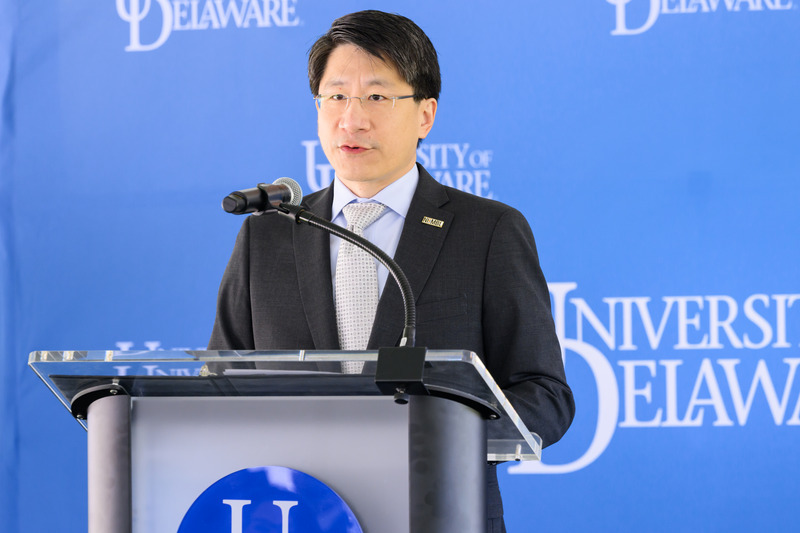
“I personally believe that the SABRE Center is going to mark an inflection point in our national competitiveness in this advanced manufacturing industry and to our resilience in the face of future public health threats,” said Kelvin Lee, UD interim vice president for research, scholarship and innovation and NIIMBL director, in opening remarks. “I also believe that the SABRE Center marks our local region’s journey moving from having a strong biotech community to ultimately being recognized as a home to a vibrant industrial ecosystem.”

UD President Dennis Assanis thanked the Congressional delegation and other dignitaries in the audience for their contributions to UD and the instrumental role they have played in fostering the biopharmaceutical ecosystem in Delaware. Groundbreaking ceremonies, he added, signal hope and the promise of new endeavors and exciting achievements to come, from the development and manufacturing of new products that can save lives and advance wellness to the creation of new manufacturing jobs that don’t yet exist.

“Through the SABRE Center, NIIMBL and many other public and private entities in the life science industry, Delaware is well on its way to becoming a unique and vibrant hub for biopharma research and manufacturing … a place where brilliant ideas become realities,” Assanis said.

UD President Dennis Assanis, joined by Delaware’s Congressional delegation, addresses UD leaders, members of the life sciences industry and other guests.

20 years in the making

Delaware’s strategic investment into the life sciences sector began about two decades ago, with the recruitment of private-sector investment to the state and higher education institutions with the goal of establishing a biotech community. One early outcome of that strategy was the formation of the Delaware Biotechnology Institute.

U.S. Sen. Tom Carper reflected on the bold and promising new direction that is developing on the STAR Campus to provide access to medicines and biopharmaceuticals that can help people lead healthier lives.

“Today’s groundbreaking builds upon all the years of work that have gone into transforming the once-shuttered Chrysler plant into the research and development hub it is today,” Carper said. “This facility will be a training center for our future biopharmaceutical workforce, as well as a testing center for biopharma companies to test their products in an FDA-regulated environment — giving us a competitive advantage to attract companies and researchers to the First State. I’m so proud of the different ways Delaware is continuing to be a force in R&D. Here, we have a vibrant research community at the University of Delaware, especially in the life sciences, thanks in large part to the Delaware Biotechnology Institute. This has served as a great model for collaboration among education, and the private and public sector.”

In 2017, UD launched NIIMBL, a national-scale public-private partnership focused on biopharmaceutical manufacturing and innovation to advance new technologies, to secure domestic supply chains and to train the biomanufacturing workforce.

A passionate advocate for economic growth, social justice and innovation, U.S. Sen. Chris Coons remarked on the more than 200 companies that are part of NIIMBL and the over $230 million in federal investment that already has been devoted to creating a biopharmaceutical ecosystem and the additional $350 million in private sector co-investment.

“But the potential is far greater. We’re about to do a groundbreaking for what is the next phase of this project. It’s not a manufacturing facility, but a test bed, a place where the new techniques of manufacturing are going to be tried out, proven out and demonstrated,” Coons said. “Spinning out from that will be a remarkable next generation of opportunities for Delawareans to work in biotech and manufacturing, for companies to be launched here and regionally and for [Delaware] to continue to be not just regional or national but global leaders in innovation.”

Kelvin Lee, UD interim vice president for Research, Scholarship and Innovation and director of NIIMBL, said the SABRE Center will mark “an inflection point” in national competitiveness in the advanced manufacturing industry.

Turning vision into reality

U.S. Rep. Lisa Blunt Rochester, a leading voice on issues related to the economy and the future of work, pointed to the SABRE Center’s planned 70,000 square feet of research space and modern technology that will one day train Delaware workers in manufacturing biopharmaceuticals.

“This is about turning vision into reality for our health, our economy and our future,” Blunt Rochester said. “It’s about safety and effectiveness. It is about the jobs of today and [the jobs] of the future. It’s about strengthening our supply chains.”

The need to create more domestic capacity for manufacturing is a reality that came into sharp focus during the coronavirus pandemic. Bringing lifesaving technologies and products to market is challenging. It requires infrastructure, investment and intentionality. Collaboration is key. These activities can be bolstered by marrying academia with the private and public sectors, Blunt Rochester said.

Designed as a current Good Manufacturing Practices (cGMP) environment, the SABRE Center will serve as both a testbed for new technologies and a hands-on training facility on STAR Campus, helping to bring lifesaving or life-enhancing medicines and vaccines to scale and ultimately into the market. In this way, the SABRE Center will support the innovation and R&D happening at NIIMBL, while filling the gap between developing new technology in a lab setting and commercializing it in a full-scale manufacturing facility.

“SABRE exemplifies the power of state and federal investments that support jobs and nurture innovation. This project, located right in a bioscience ecosystem, supports the First State’s student pipeline and ever-growing biopharmaceutical workforce,” added Lt. Governor Bethany Hall-Long, the state of Delaware’s representative on NIIMBL and a professor of nursing at UD. “I’m competitive, so I want Delaware to excel regionally, be a destination and provide the best quality of life for our residents. SABRE is a solution to sustain and create jobs for the state as well as respond to industry and global challenges. As a research scientist and STEM champion, this is a big deal.”

Additionally, the UD STAR Campus’ location along the I-95 corridor and proximity to other biopharmaceutical activity nearby from New York to Greater Washington, D.C., is a tremendous opportunity for Delaware to add capacity in a key location along the East Coast.

Delaware Gov. John Carney, who was unable to attend the groundbreaking, is a long-standing champion of UD research and helped to secure funding support for the SABRE Center and NIIMBL, among other projects. In a statement, Carney illustrated the value of supporting such programs and the partnerships and collaboration necessary to bring them to fruition.

“Our partnerships with institutions of higher education have never been more important,” Carney said. “We need to support programs that build the future workforce and encourage businesses to land and grow in the First State. SABRE will complement the nationally recognized work in biosciences happening at NIIMBL and the University of Delaware. I look forward to SABRE’s contribution in Delaware’s science and technology sector.”

This article was originally posted on the University of Delaware website at: https://www.udel.edu/udaily/2024/april/biopharmaceutical-manufacturing-research-education-center-sabre-niimbl/.

Newsletter Sign Up

Stay Up To Date With Delaware
Continue reading

New Business Dean Has Big Plans at UD

New Dean Focuses on Making UD Business School Authority in Multiple Fields, Producer of Must-Hire Graduates

Photo: University of Delaware/Evan Krape

Dr. Oliver Yao aims to expand research and digital tech initiatives and increase student experience opportunities and programming in high-demand market skills


Dr. Oliver Yao, who was appointed dean of the University of Delaware’s Alfred Lerner College of Business and Economics in 2023, says he’s excited at the potential he sees to put UD and Lerner on the leading edge of financial technology (fintech) and increased research productivity.

Yao came to UD after 20 years at Lehigh University, where his final role was overseeing graduate programs and graduate students. He was attracted to UD’s vision for collaboration on technological innovation, featuring researchers, industry and the community.

“I would like executives from at least Boston down to Washington, D.C., saying they must go to Lerner and the University of Delaware to hire students. And we want a reputation that will attract more great professors, great faculty, great staff and great researchers to the University.”

Dr. Oliver Yao

Yao sees UD and the Lerner College as a critical partner to the region’s economic growth. He says the College has a responsibility to the community to provide opportunities for economic development with startup companies and the ability to influence policy with cutting-edge research.

Lerner has 163 faculty members serving 3,300 undergraduates and 1,000 graduate students, with 17 undergraduate majors and 16 minors, nine master’s programs and four doctoral programs. Yao expects those numbers will grow quickly over the next few years. In the interview with Delaware Prosperity Partnership that follows here, he shares why.

What have you been focusing on in your first months at UD?

We’re focusing on being innovative and entrepreneurial. We’re developing greater technology competency in our majors and minors in fintech, adding more experiential learning opportunities and more global perspectives. We’re also adding new workshops on topics around generative artificial intelligence (AI).

Our Center for Economic Education and Entrepreneurship (CEEE), Office of Graduate and MBA Programs and a cluster of faculty members has relocated to the FinTech Innovation Hub, which is located on the STAR Campus. We’re going to move the Ph.D. program to that building as well.

What’s the benefit of moving people into the Fintech Hub?

Fintech is interdisciplinary in our field. We have faculty from management information systems, finance and management to collaborate on research. We can also collaborate with our College of Engineering colleagues who are on the same floors with us and with companies on the STAR Campus. CEEE has access to resources to grow our economic education and financial literacy programs for K-12 schools in Delaware.

What are business and governmental leaders and alumni telling you they’d like to see?

They don’t really get into the curricular issues, but they want to help. We hope to introduce more leaders to our Executive Mentoring Program and Lerner Edge programs, which support professional and career development guidance for our students. They also are reinforcing the importance of being at the forefront of cutting-edge technology.

Everywhere I go, I hear businesses say they need people with generative AI skills. One executive said, “If you graduate any of them from Lerner, I’ll hire them.” So that’s a clear message to us. We need to revise our education to include high-demand market skills, including people and leadership skills.

What would you like to accomplish by the end of your first year?

I want to move Lerner’s research forward. Finding more grants and donations will be very important to support faculty research. I told my internal Dean’s Advisory Council that I want research to be the first thing we talk about when we meet, before we move on to other topics. That’s how I can show that this is my top priority.

Are you encouraging any particular research?

In general, I cannot tell our faculty what kind of research they need to do. But I can invest in grants for specific topics. For example, we’re going to appoint six FinTech Scholars and move them to the FinTech Innovation Hub. I do encourage our faculty to do more high-impact research that addresses grand challenges today. For example, I attended a research symposium about gender equity and equality where our researchers and faculty talked about their work.

What role do you see for Lerner outside the University?

Continuing to contribute, give back and being a partner with the local community. CEEE is a valued resource to the Delaware school system and in the state with programs such as Teach Children to Save Day.

The Lerner Diversity Council focuses on curricular and co-curricular transformation and strengthening community outreach and improving engagement. It partners with the Delaware LYTE program to familiarize high-school students with the University and the application process.

We are also partnering with the new Center for Accelerating Financial Equity (CAFÉ) in the FinTech Innovation Hub that supports early- to growth-stage fintech companies creating innovative solutions to advance financial wellness for underserved and low- to moderate-income communities. The first cohort of companies will arrive in early 2024.

And we plan to use more adjuncts from local businesses, particularly for special topics that our faculty may not have expertise in and those that expose our students to an entrepreneurial mindset.

Tell us more about expanding experiential learning at Lerner.

Redefining creativity, innovation and entrepreneurship is a core part of UD’s strategic plan and central to expanding experiential learning at Lerner. The Geltzeiler Trading Center enables finance students to use the same commercial software that Wall Street traders use to analyze stocks and make transactions. The Blue Hen Investment Club allows 50 students to manage a real-dollar investment portfolio. They have continued to achieve their goal of outperforming the S&P 500 Index for a long time.

Vita Nova is a student-operated and -managed restaurant on campus. We offer hands-on hotel management experience in the Courtyard by Marriott hotel and teaching facility on campus. The top-ranked Horn Entrepreneurship program is the creative engine for aspiring innovators and entrepreneurs with its pitch competitions and much more.

We must provide enough opportunity for all students to have these experiences. That’s the challenge I’m going to take on over the next few years.

Are there any technologies you’d like to see students or faculty better leverage?

On a broad scale, I would say generative AI. Our management information systems (MIS) faculty are the most familiar with this technology. However, all your faculty and students need to know what generative AI can do because it impacts all facets of business and the economy.

We’re in the process of creating a graduate certificate focusing on generative AI for business. We’re starting new courses, and we’re going to do more workshops on generative AI to make sure our faculty, staff and students are familiar with the technology.

In the past, our students have used Excel and Python to create models to solve business problems, but those applications may soon be obsolete. When students graduate, employers won’t be looking for Python and Excel skills. They’ll be looking for generative AI modeling skills. I want our students to be able to list those skills on their resumes.

What do you want to hear people saying about Lerner in five to 10 years?

I want us to have three to five fields – we’re not large enough to cover everything – where people point to us and say we’re the authority. We have some great researchers, but I want Lerner’s research profile to rank among the most productive in the country. During strategic planning this spring, I’ll be asking our faculty to help me decide on areas beyond fintech. That could include finance, economics, leadership, corporate governance, supply chain management, accounting and compliance.

I would like executives from at least Boston down to Washington, D.C., saying they must go to Lerner and the University of Delaware to hire students. And we want a reputation that will attract more great professors, great faculty, great staff and great researchers to the University.

Newsletter Sign Up

Stay Up To Date With Delaware
Continue reading

Sussex Incubator Supports Food Startups

Cooking up Success, Southern Delaware Kitchen Incubator Aims for Culinary Revolution

The Georgetown facility provides a much-needed solution for business owners facing challenges in finding a place to cook in southern Delaware.


By Johnny Perez-Gonzalez

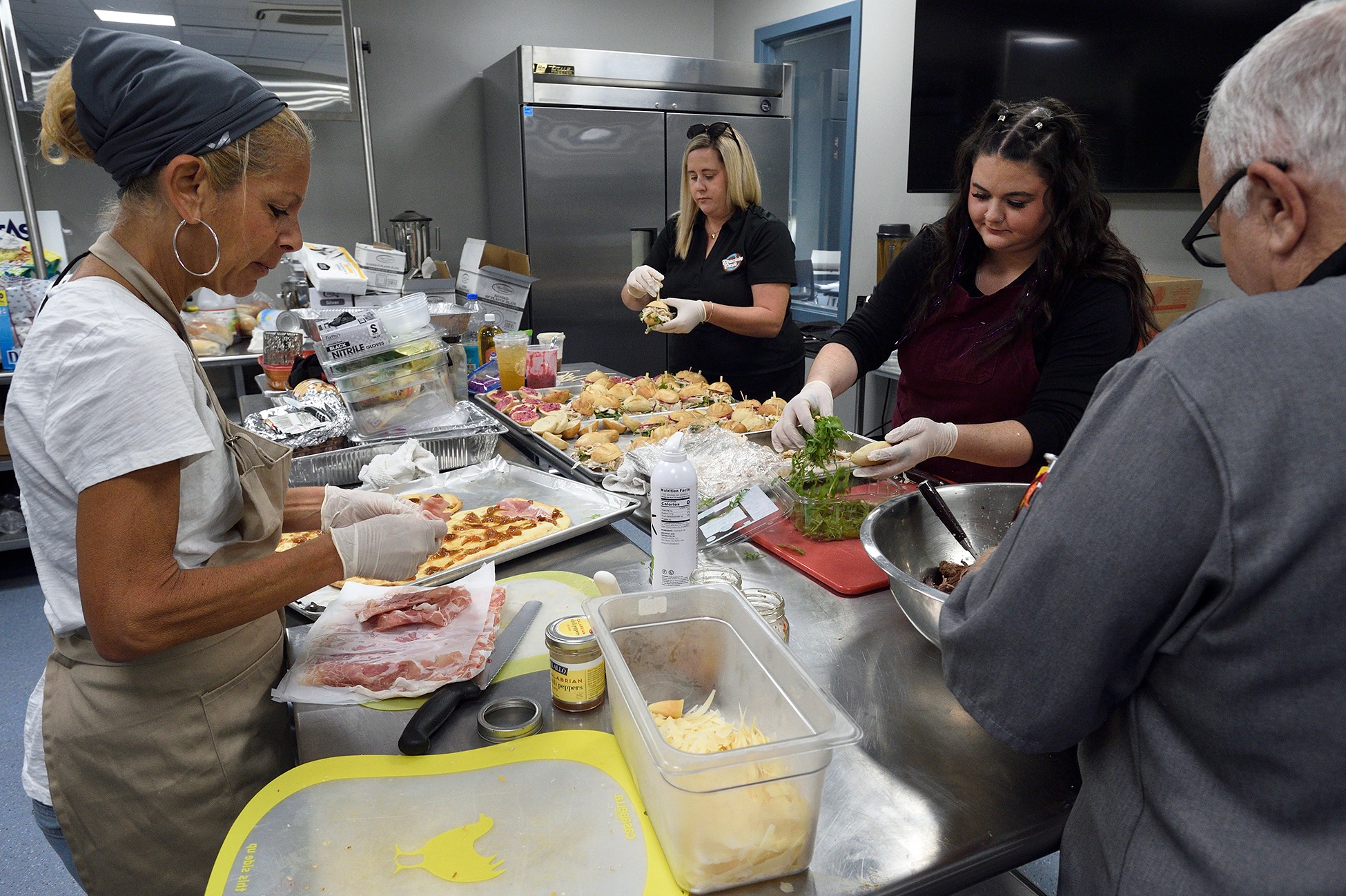
Starting a small food business just got easier in southern Delaware after county officials unveiled a new kitchen incubator to support “foodpreneurs” looking for a space to cook up their fusion of food blends.

Items now being produced at the centralized kitchen range from key lime pies to hot sauce, breads, and pizzas. The initiative is helping pave a new career pathway for residents in mostly rural Sussex County.

The county’s director of economic development Bill Pfaff identified the need for a commercial kitchen to help small businesses produce their goods.

“One of the things that I constantly heard from foodpreneurs was there wasn’t space for them to produce their product to take the commercialization because you must produce your food products in a licensed commercial kitchen,” Pfaff said.

The pandemic hindered the county’s efforts to get the kitchen up and running.

“I started working on this kitchen incubator pre-COVID, and then COVID hit, everything had to come to a standstill, but we never gave up, we continued to work on it,” he said. “It ended up taking a little bit more work to do because of the federal shutdown.”

After years of effort, the incubator was finally made available for use in a soft launch in late April, with two dozen food business owners currently utilizing the space. The grand opening attracted a wave of entrepreneurs eager to leverage this innovative resource.

Jessica Williamson of Milton was part of that first wave with Coastal Key Lime Pie, the company she co-owns. The creation of the kitchen incubator allowed Williamson and her husband Lee to bring their unique key lime pie to the coastal area.

Since discovering the incubator at Delaware Technical Community College’s Georgetown campus, the pastry chef says the demand for her pies has skyrocketed.

“We were the one of the first ones to sign up, this was back in May,” Williamson said. “That allowed us to quickly get our permit to be able to sell the pies at our local farmers market and we really [have] grown since then pretty amazingly … it was just hard to keep up [with] the demand.”

After working in human resources for more than 15 years, Williamson says she never imagined branching out into a new career. But with the foundation provided by the kitchen incubator, the couple now plans to open their own kitchen nearby.

“This is like a totally new industry for us to learn and grow in. I’ve done this my whole career and now I’m ready to try something new and venture out and see where it takes us,” she said. “We’ve already started plans for renovating our own space and having our own little small kitchen, which will be in Seaford.”

Pfaff says the incubator helps entrepreneurs deal with the big expense of starting a food-based business, including building a kitchen from scratch, providing their own kitchen tools, and doing maintenance.

“The purpose of the kitchen incubator was to help remove restrictive barriers of high cost capital investment associated with leasing or purchasing a commercial kitchen and kitchen equipment,” Pfaff said. “We’ve taken that headache out of the mix.”

“The kitchen incubator also reduces the risk of failure by removing additional startup barriers in areas of managing and maintaining a commercial kitchen,” he said. “We take care of everything.”

In addition to providing the kitchen to cook with, the county also offers resources needed to elevate the business.

“We also provide technical assistance in training and value-added services related to distribution, branding, marketing, pricing, insurance, legal services and financial opportunities,” he said. “When you go into business being a foodpreneur, being an entrepreneur, you’re working for the business. You want to get it to a point where the biggest business begins to work for you and we give you those tools to achieve that.”

To take advantage of this resource, individuals have to be in good standing with state permit requirements, obtain the ServSafe certification, and be insured. Afterwards individuals are able to pay for a membership to gain access to the kitchen.

After that, it’s up to them to bring the food and start cooking away.

This article was originally posted on the WHYY website at: https://whyy.org/articles/delaware-georgetown-kitchen-incubator-foodpreneurs/

Newsletter Sign Up

Stay Up To Date With Delaware

Continue reading